
Written in 2024 and 2025
Here is how I started to get my ideas for my YR8 school history project:
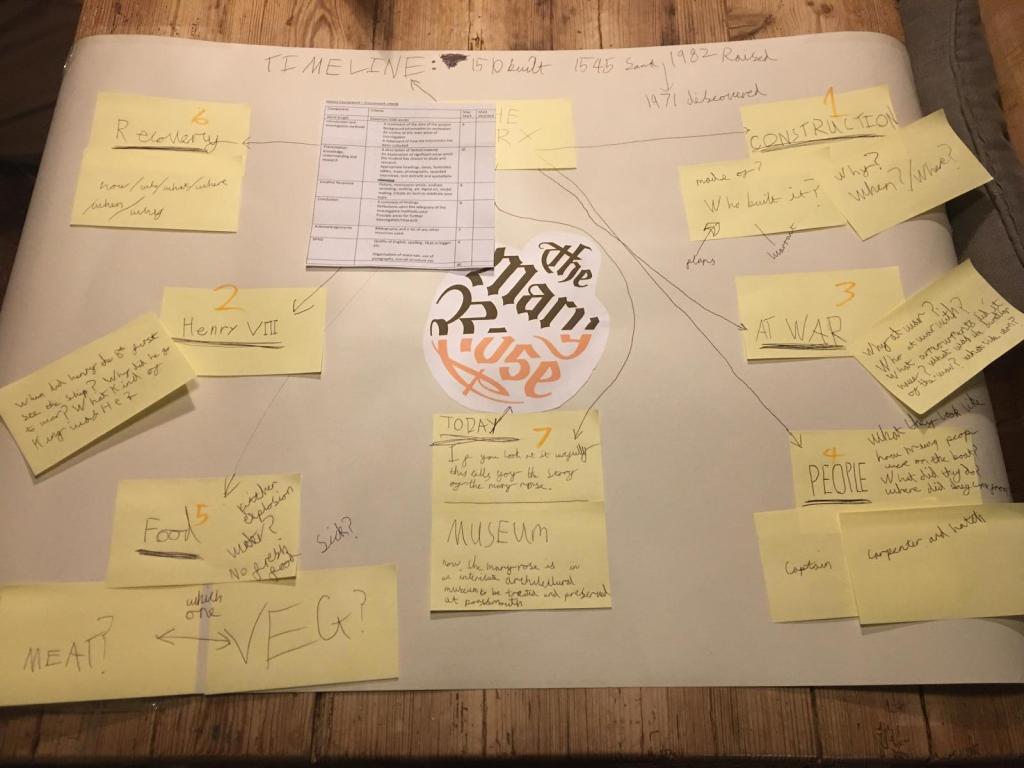
My mind map of my project on the Mary Rose with the main sections of People, Henry VIII, At Sea, Construction, Food, Now and Recovery. As well as my creative response to the Mary Rose project which was when I built a model of the ship.
These are my ideas and show how I started my project. It also shows the order I originally wanted to do things in and explains the questions that I wanted to answer at The Mary Rose Museum when I visited.
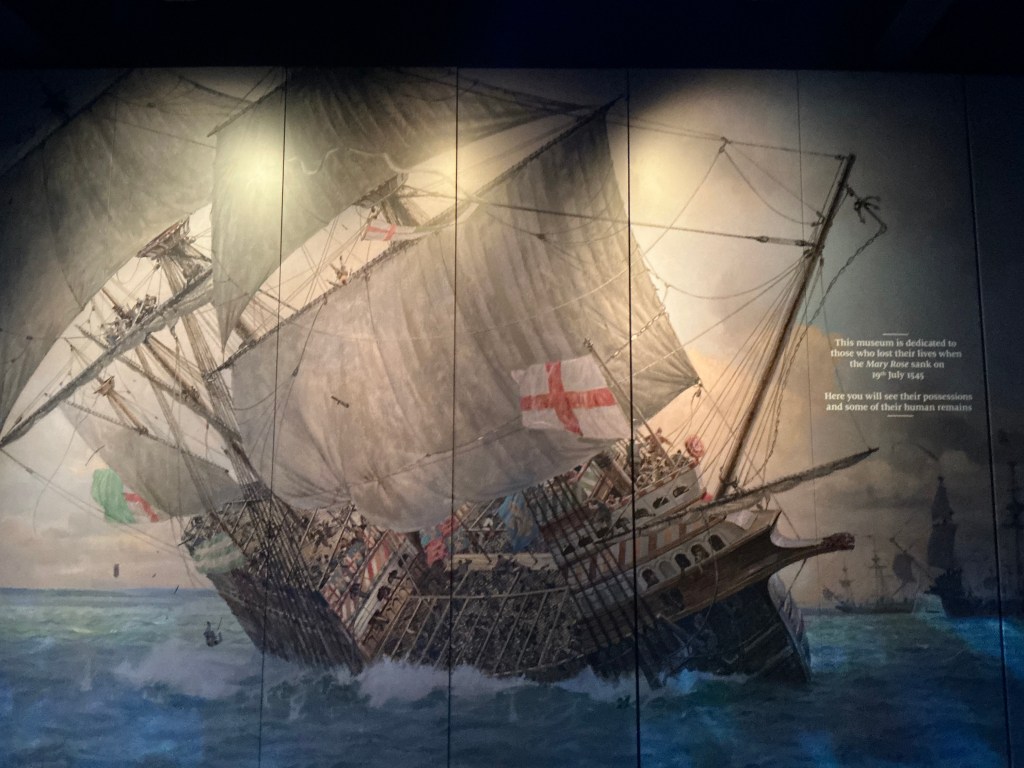
INTRODUCTION
This project is to teach the reader all about The Mary Rose.
I have chosen The Mary Rose because I like boats and I enjoy Tudor boats because I have seen them at Portsmouth Historic Dockyard.
I will explain how it was built, who it was built for, when it went to war, who was on the ship, how they lived on the Mary Rose and how it was recovered from 400 years under the sea.
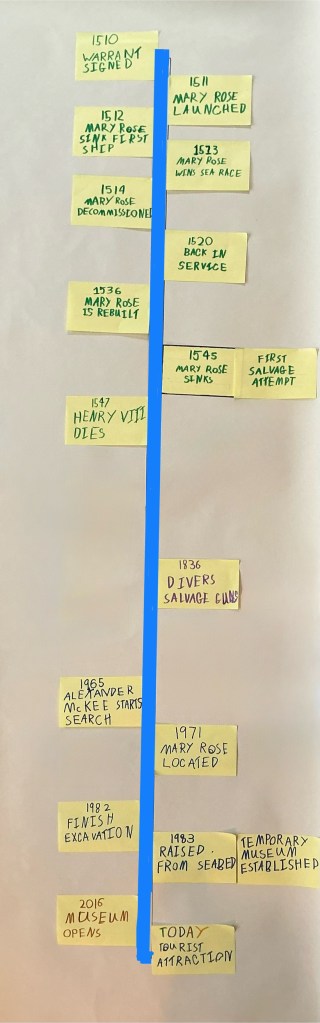
The timeline for this project is from the Tudor Period of English History, when Henry VIII was on the throne, in 1510, to today.
CONSTRUCTION
The Mary Rose was an ambitious project by Henry the Eighth. He was King of England at the time.
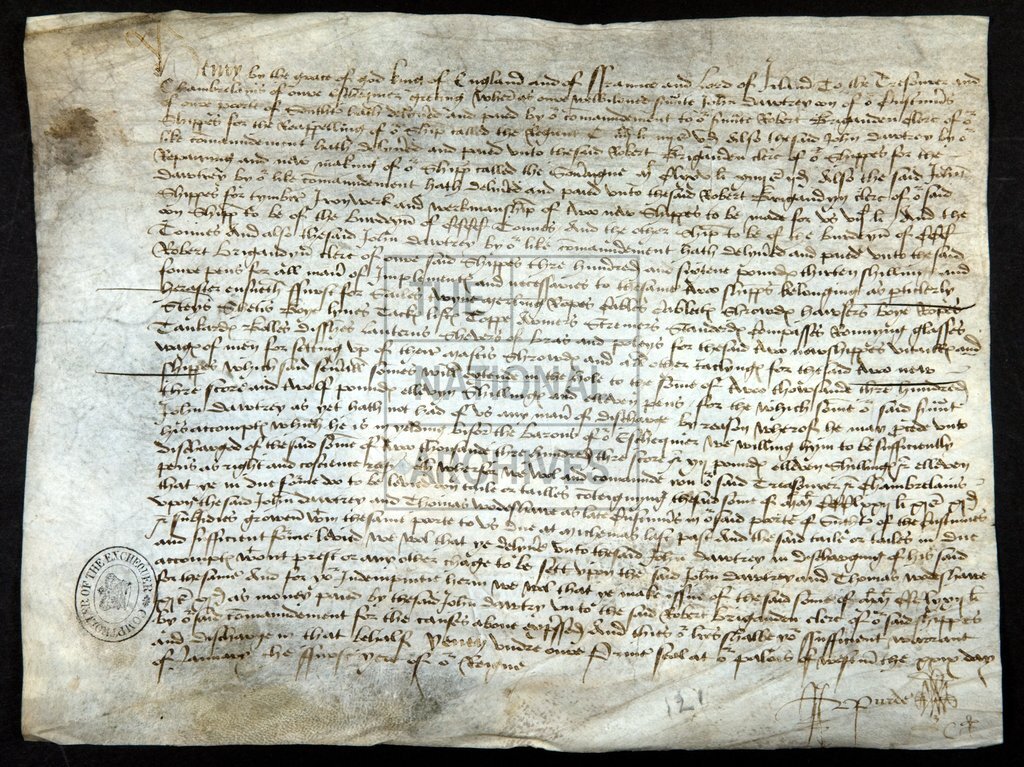
The warrant for the building of the Mary Rose was signed in 1510 by Henry so that construction could start.
The Mary Rose was a Tudor flagship presented to Henry VIII by the Royal Navy. It was his favourite ship.
It sank off the coast of Portsmouth in 1545.
It took 600 trees to build The Mary Rose, which would cover 40 acres of woods.
The trees were Oak and Elm and because there was a shortage of very tall trees in 1510 there was a huge hunt to find trees that were large enough to build the ship. So the search was all over southern England for trees tall enough.
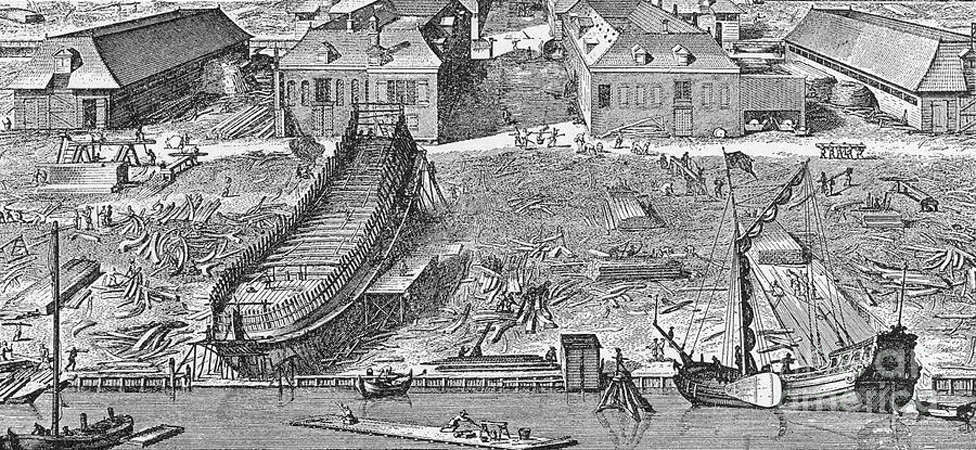
This photo shows a 16th century shipyard which may have been similar to how the Mary Rose was built.
The shipyards were busy, noisy and hectic places because to build a big ship you need a lot of carpenters and a shipwright, who would work out the dimensions and design of the ship.
Building a ship then was a case of ‘if it looks right it is right’. The shipbuilders did everything visually once the designs were official.
The first step in building the boat was to get a single tall tree to make the keel. If it was more than one tree it might have splintered.
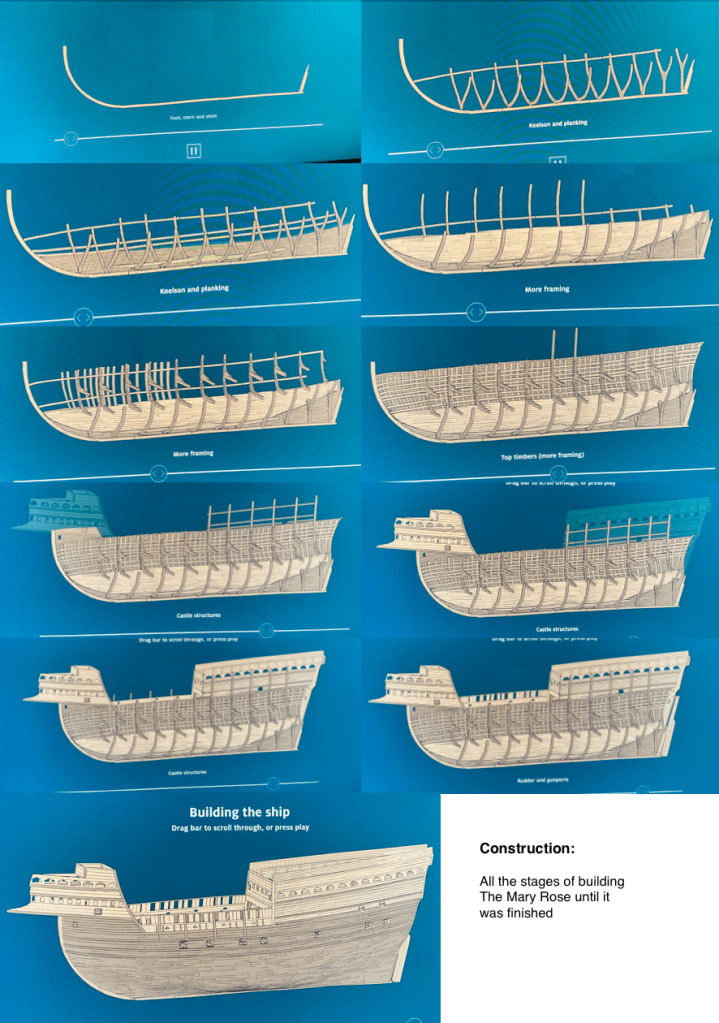
There were no machines apart from basic tools like hammers, chisels, axes and saws. This made it a slow and tiring process for anyone who tried to build a ship at this time in history.
The Mary Rose was built in Portsmouth. It took two years to construct and is a carrack style boat. This type of boat normally has three masts but the Mary Rose had four. The ship was rebuilt in 1536 with three-storey fore and aft castles. They weighed 200 tons so they added a lot of weight meaning the ship was top heavy after that.
When she was in battle with the French at the Battle of the Solent she heeled to starboard and an unlucky gust of wind capsized her. The Mary Rose sank in seconds.
Water flowed in through the gunports and the crew couldn’t balance the ship and they rushed to the top deck. All the storage containers were loose and the cannons, which were also loose, added to the chaos.
The Mary Rose was very top-heavy, which could possibly have helped to explain the sinking, which was only one mile off the English coast in shallow water.
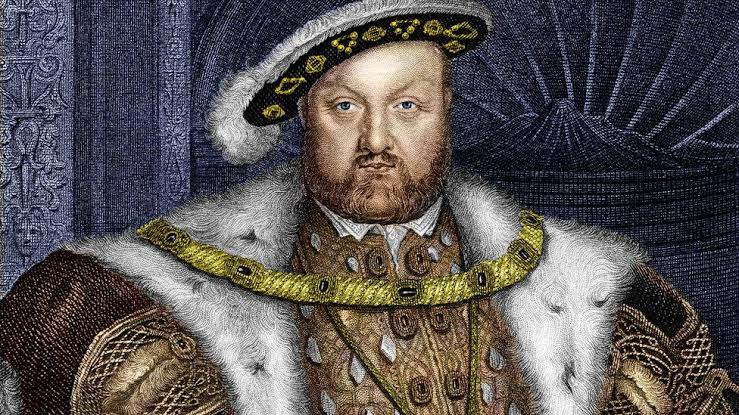
KING HENRY VIII
King Henry VIII constructed 48 ships to create a navy. When he became king he started with five ships and had 53 when he died two years after the Mary Rose sank in 1545.
Henry was rebelling against the church in Rome and because he was worried about that he had the Mary Rose refitted with more gunports and the ship was strengthened
The Mary Rose was his favourite ship and the first ship that Henry VIII had built.
Henry wanted a strong navy so that his kingdom wouldn’t be overthrown.
Henry named the ship Mary Rose after his favourite sister, who was also queen of France. She was called Mary. The Rose was the symbol of the Tudor family.
Henry VIII chose his friends and favourite people to be captains on his ships not sailors.
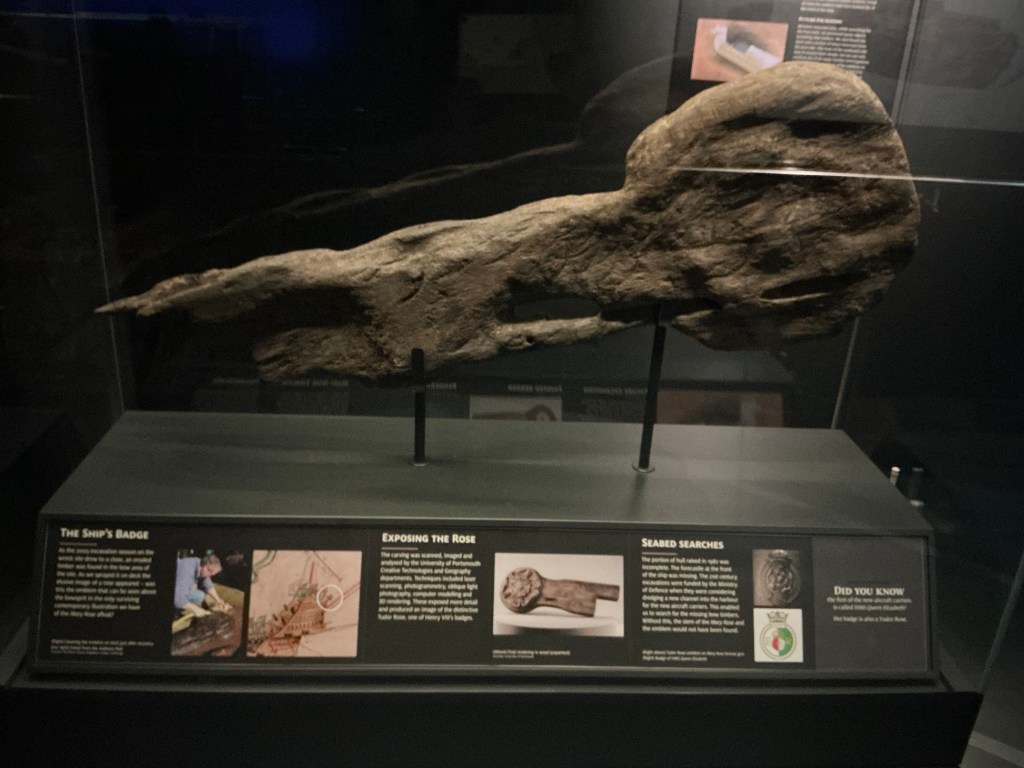
This is the Tudor rose rescued from the front of the ship
AT SEA
The Mary Rose was a very good handling ship. She took part in a race against nine other ships in 1513 and won. The people who saw her thought she was the best ship they’d ever seen. She finished half a mile ahead of The Sovereign, her closest rival.
Admiral Edward Howard said about the Mary Rose that it was “The noblest ship of sail of every great ship at this hour that I believe to be in Christendom.”
The ship handled very well in rough seas due to the shape of her hull.
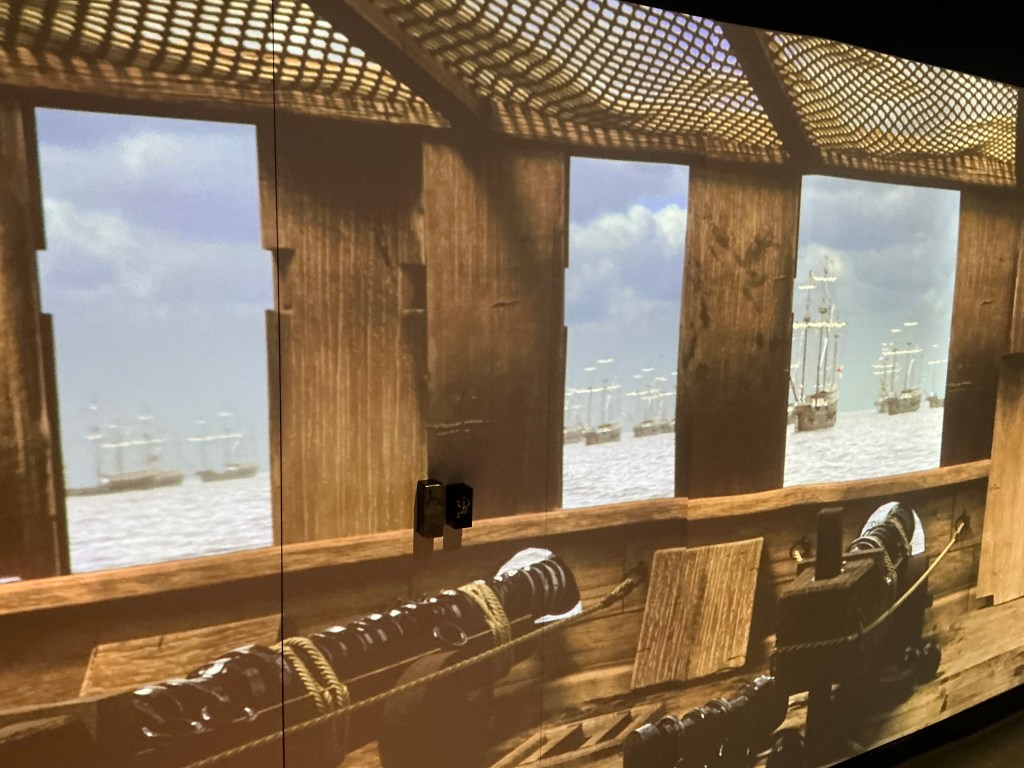
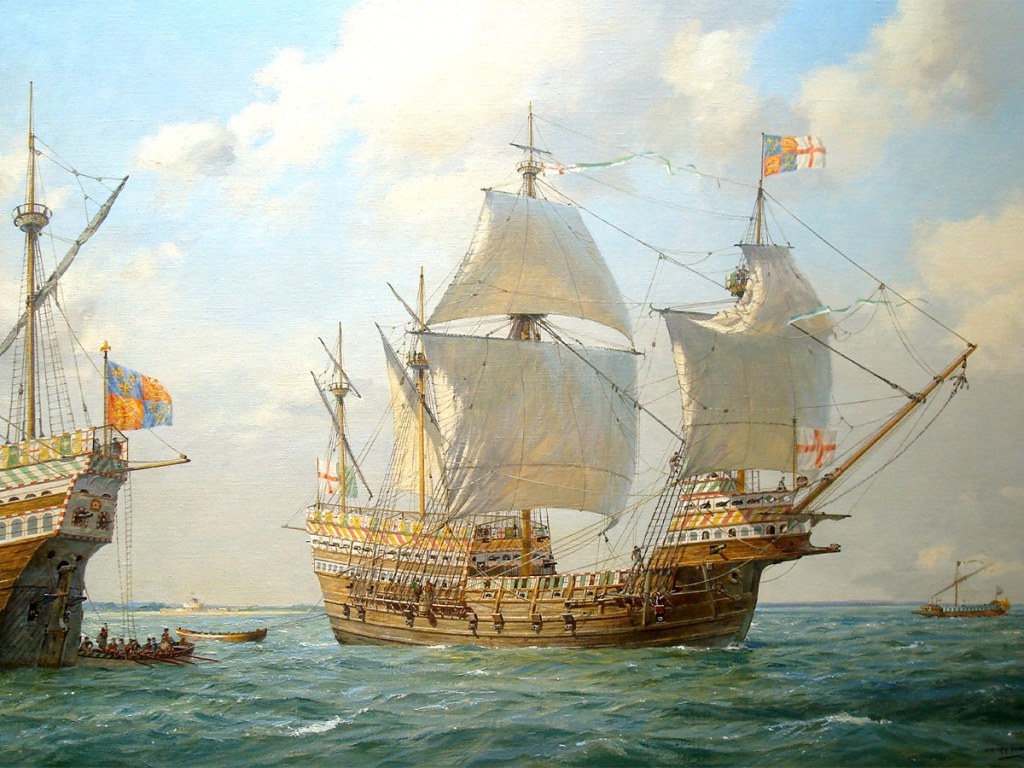
The Mary Rose was rebuilt years later and was top heavy after that. The work really changed how she performed.
In the Battle of the Solent, she was moving to starboard and an unlucky gust of wind caught her and took her down. It was only in the battle for a few seconds and after it sank the French withdrew.
When she sank she had 91 guns onboard and 500 men onboard, 35 survived.
The Mary Rose was so popular it was chosen as flagship of the navy by Sir Edward Howard, Lord Thomas Howard and Sir William Fitzwilliam. They were all Lord Admirals of England and were appointed by Henry VIII.
THE PEOPLE
I chose these people because they are some of the important people that were onboard the ship. They were responsible for some of the most important jobs on the Mary Rose.
The Captain
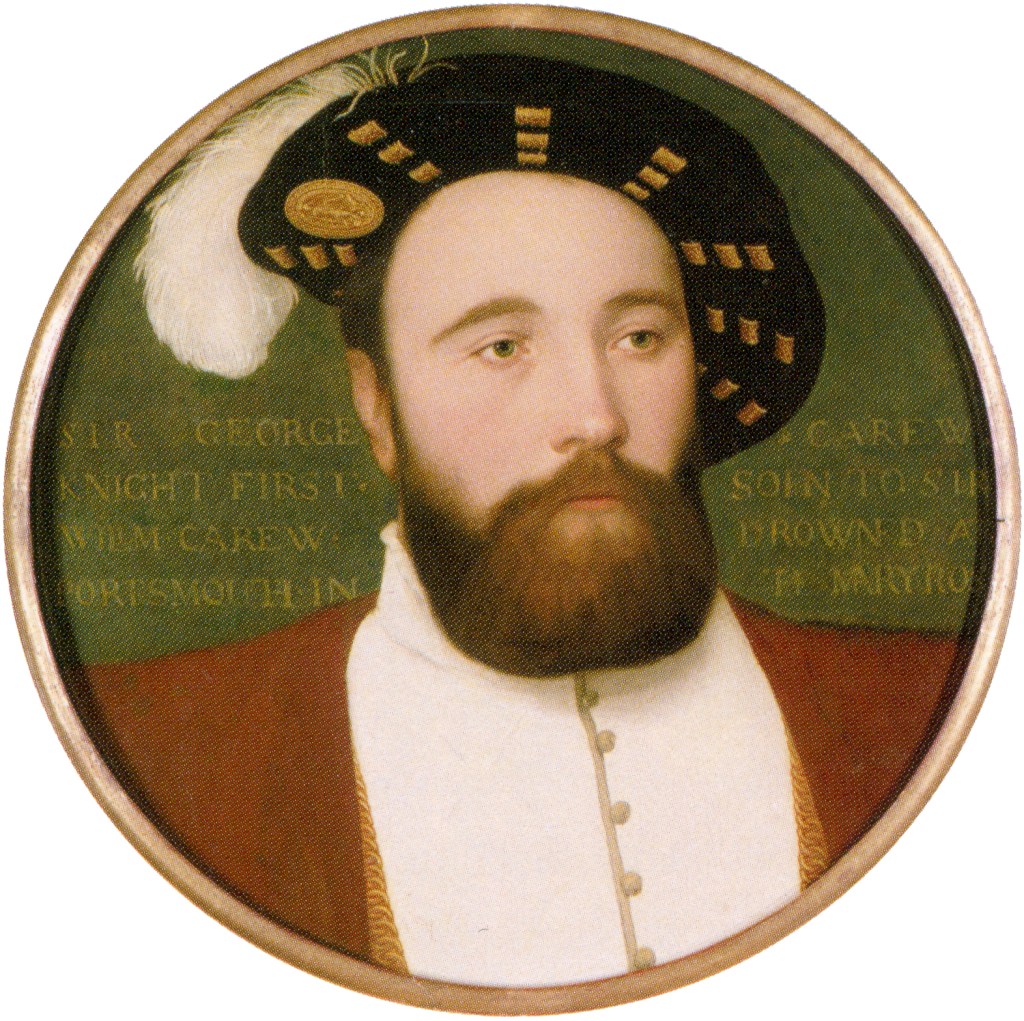
Henry VIII chose his friends to be in charge of his ships. He chose Sir George Carew to be the captain of the Mary Rose. He had the title Vice-Admiral and was and English soldier and adventurer who died when the Mary Rose sank. He was 41 years old when he died in the Solent. He was also a trusted army officer and had fought against pirates in the English Channel.
On the day of the battle in the Solent George was gifted a golden whistle by Henry VIII when he was on the Henry Grace A Dieux. This was to symbolise that he was in charge of the fleet.
His last words were to his uncle and were that he did not have the authority over the men on the Mary Rose and that there were discipline problems.
The Surgeon
We don’t know the surgeon’s name but his job was to look after all of the men on the Mary Rose. His cabin was discovered with many beakers and bottles which might have been full of medicines. His bandages were ready rolled and covered in beeswax and they were like a plaster cast.
The surgeon’s cap which was found on the Mary Rise shows how experienced he was.
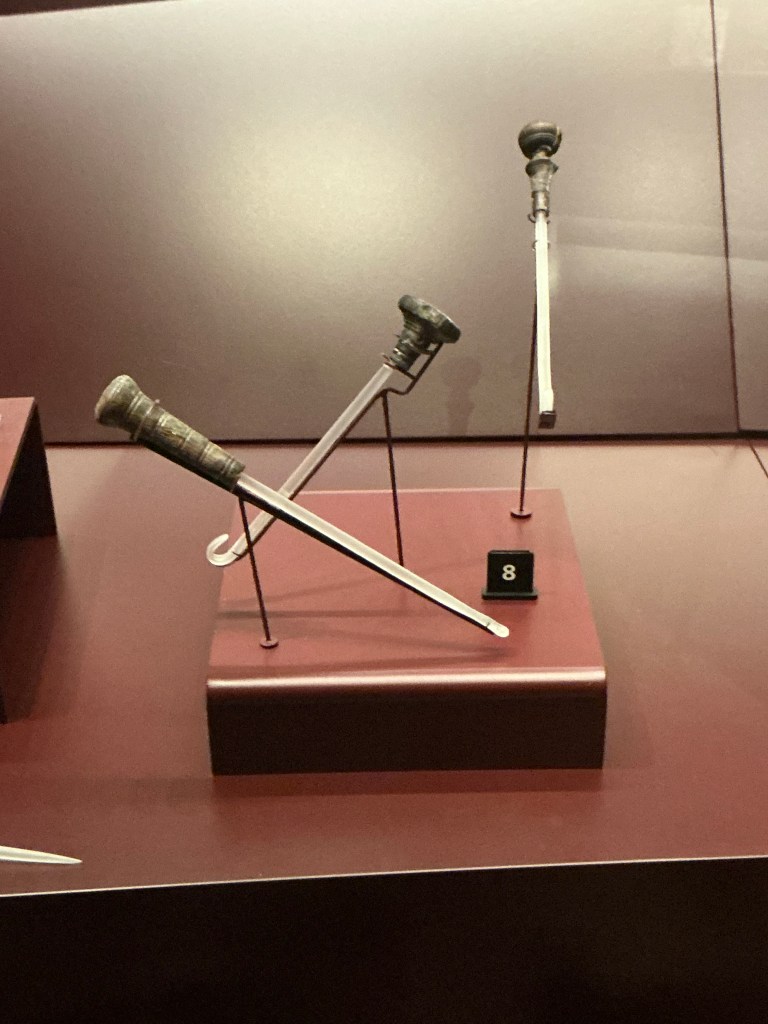
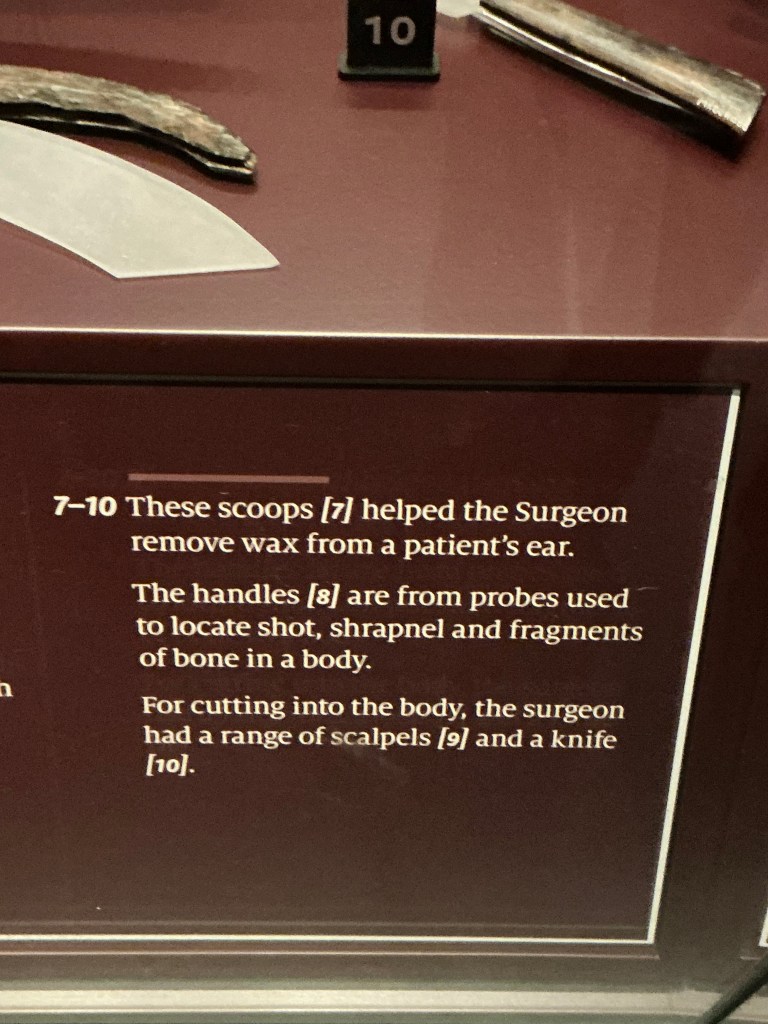
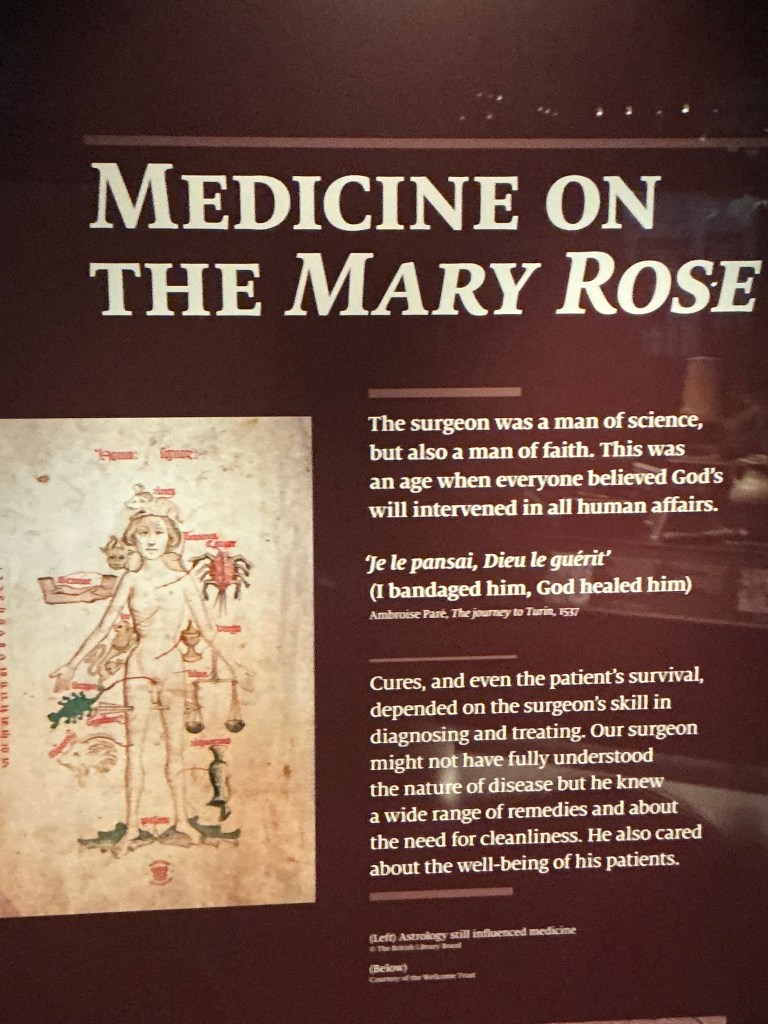
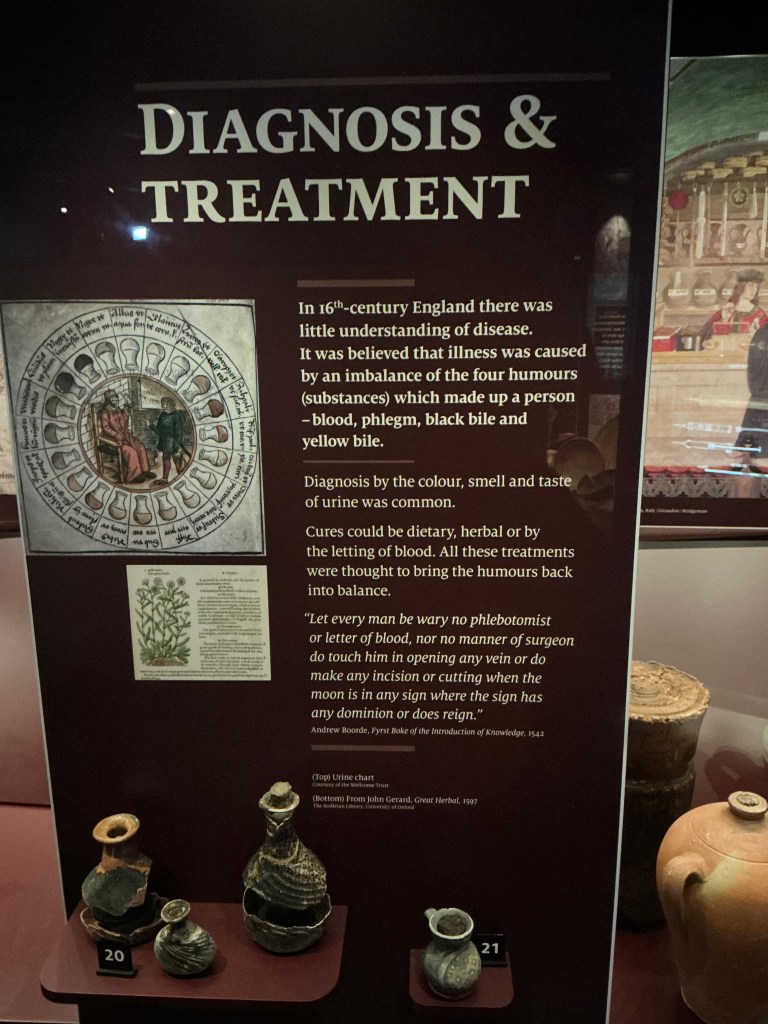
His cabin was on the main deck of the ship and was small and dark and there was only enough room for him and his medicines. Experts think that the surgeon took his patients down to a lower deck where there was more space for treating them.
If someone with a broken bone didn’t heal, the surgeon would amputate it with no anaesthetic. So he would do it as quickly as he could.
Experts assume that the surgeon died on the Mary Rose when she sank.
The Master Carpenter
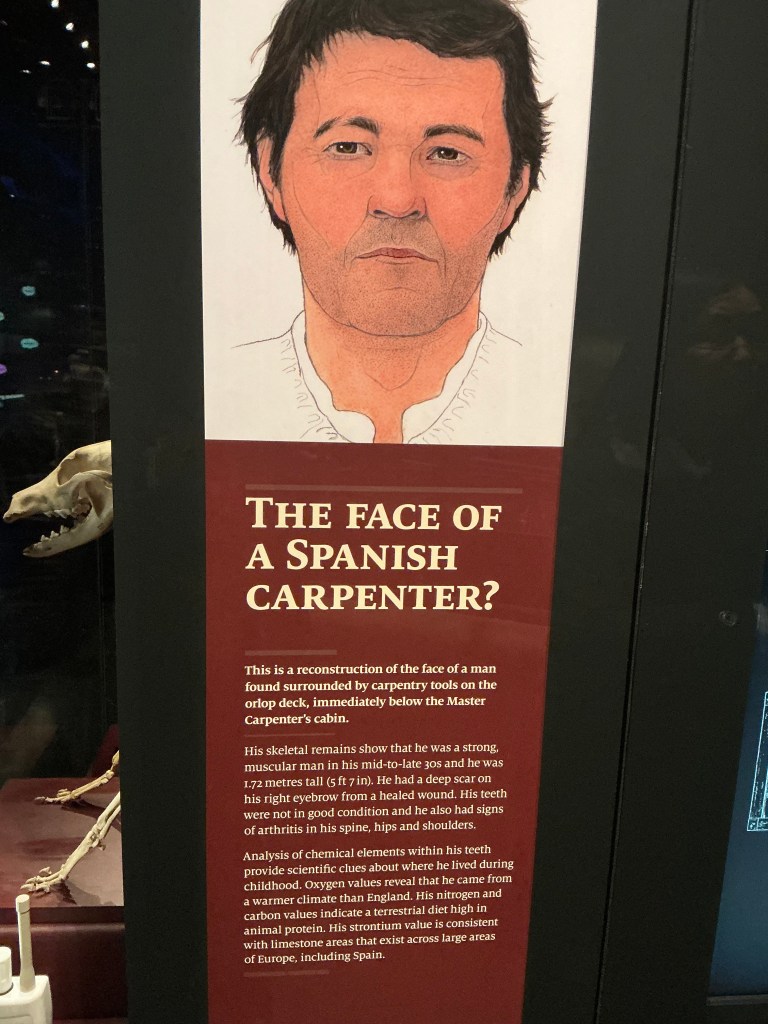
During the excavation a complete cabin was unearthed which was the Master Carpenter’s Cabin. It contained hundreds of tools, including a multi-tool, saws and a mallet which are all on display.
He wore thick leather boots with no laces which had heavy wooden soles. Part of them survived and are on show at the museum. He had spare clothes which was unusual. He kept them in a wooden chest in his cabin. This suggests that he was a very powerful and high status person onboard the ship. He appears high up in the ranking for the Mary Rose, there is a photo of this.
He owned what was known as a ‘tables’ set which later became backgammon. The backgammon set is in almost perfect condition after hundreds of years under the sea and could still be used today. Only a few of the backgammon counters survived.
The skeleton of a carpenter was found directly below the Master Carpenter’s Cabin on the Orlop Deck. His remains show that he was strong man and was in his 30s when he died. He was 1m72cm tall and he had arthritis because there were signs in his spine, hips and shoulders.
He was thought to be Spanish because of the amount of strontium and limestone in his body which existed in large areas of Europe, including Spain. Tests showed that he was also a meat eater.
Hatch the Dog
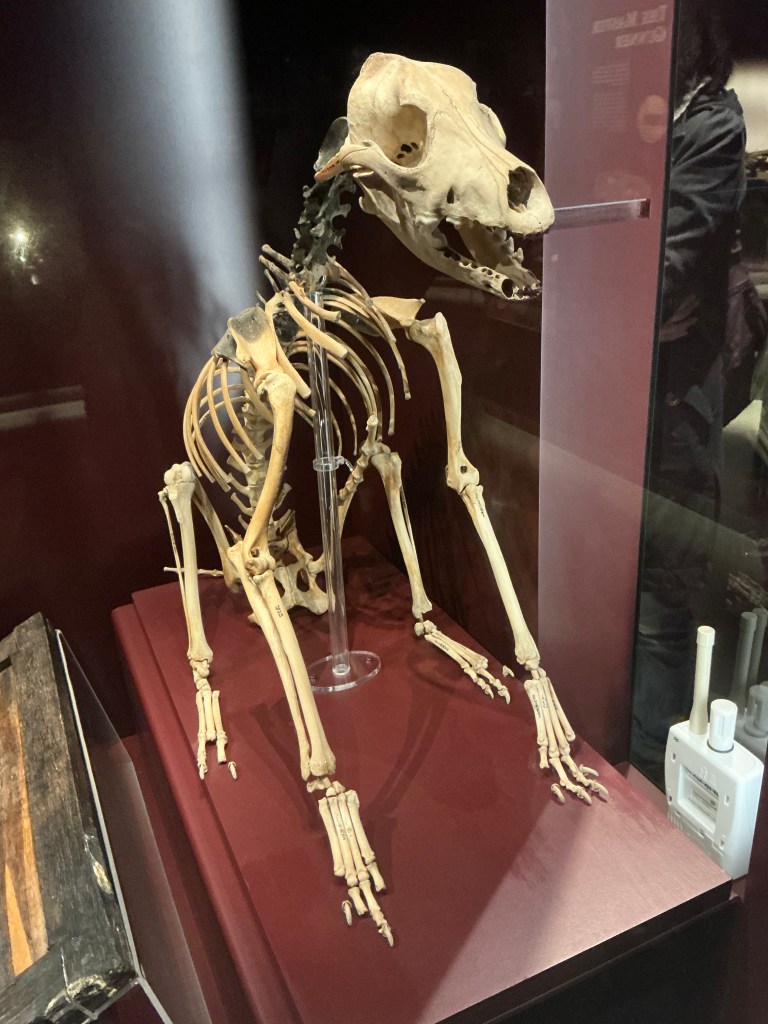

Hatch is the carpenter’s companion because he was found outside the carpenter’s cabin.
The remains of the dog show that he was a young adult male and was roughly 18 months of age. He had a brown coat after scientists analysed DNA from his teeth.
Most dog breeds were developed after 1545 so that means we can’t say exactly what breed he was. But DNA analysis at the University of Portsmouth says he was closely related to a modern day Jack Russell terrier. He may also be related to whippets or lurchers.
On the Mary Rose his job was to be a ratter because cats aren’t big enough to be good ratters as the rats can fight back. Dogs on the other hand eat them anyway. The Pope declared cats to be unholy in 1484 and declared cats to the companions of witches so owning one was unlucky.
Hatch may have been born on the Mary Rose and lived his whole life there.
LIFE ON THE MARY ROSE
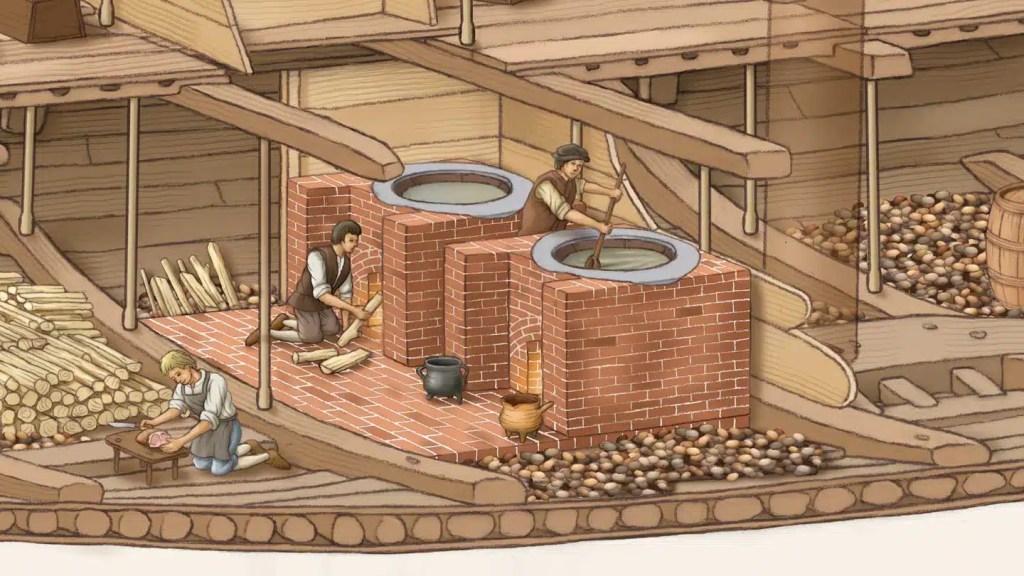
The Mary Rose had two kitchens. One on port and one on starboard but when it sank the one on the port exploded!
There were two kitchens because if there was one the boat would have been permanently keeling over to one side.
The hold was where sailors kept their provisions. There was beer, water, meat, biscuits and peas. There was also wood for repairs.
When they ate, it was in roughly groups of ten called a mess. Officers wouldn’t have eaten with lower ranks. They’d have eaten together.
No mess tables were discovered on the Mary Rose so the crew probably sat on the decks to have their meals.
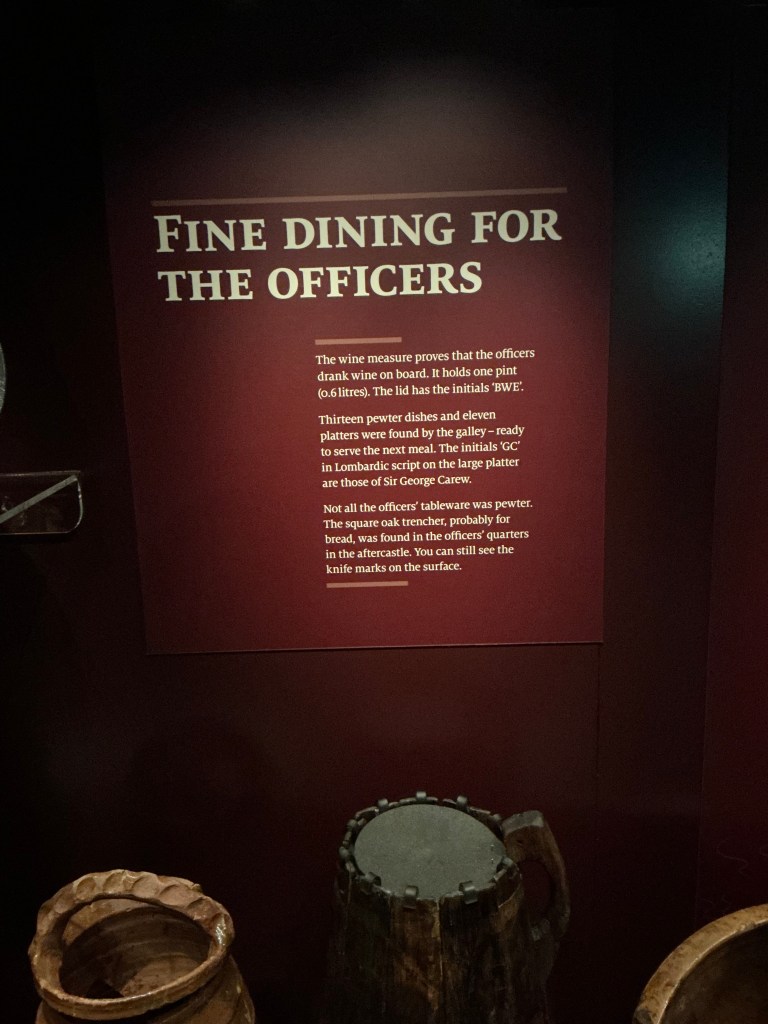
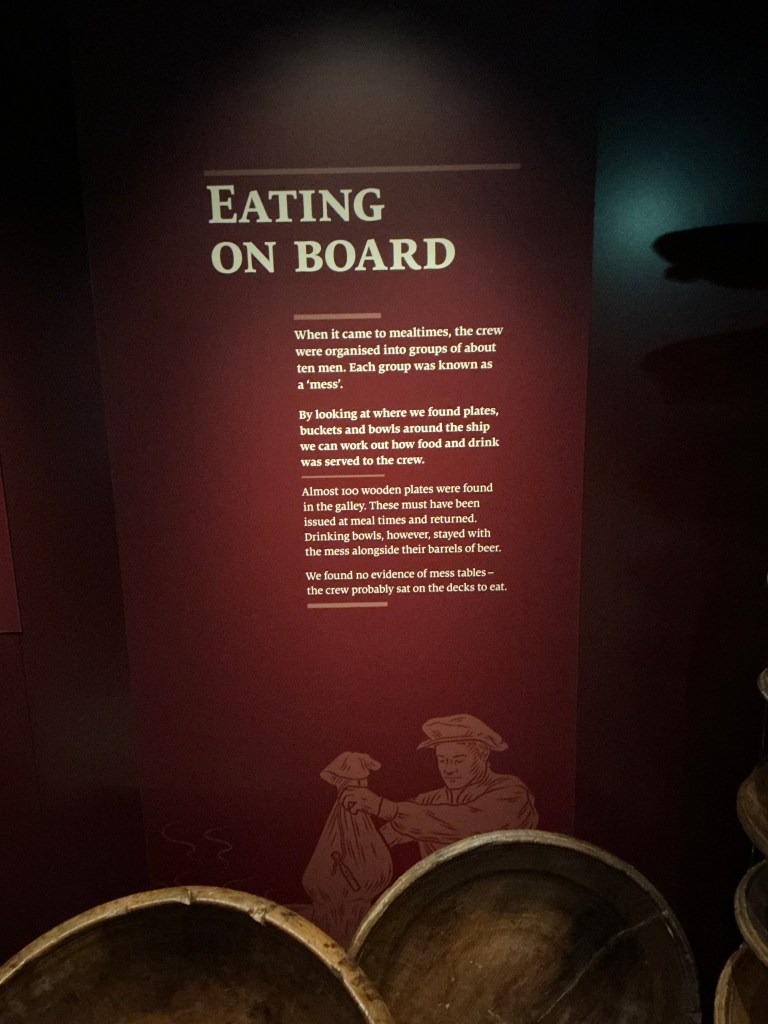
The officers had a wine measure to share out the wine. It held one pint and it had a lid with BWE on it. Thirteen pewter dishes and 11 plates were found to serve the next meal in the wreck.
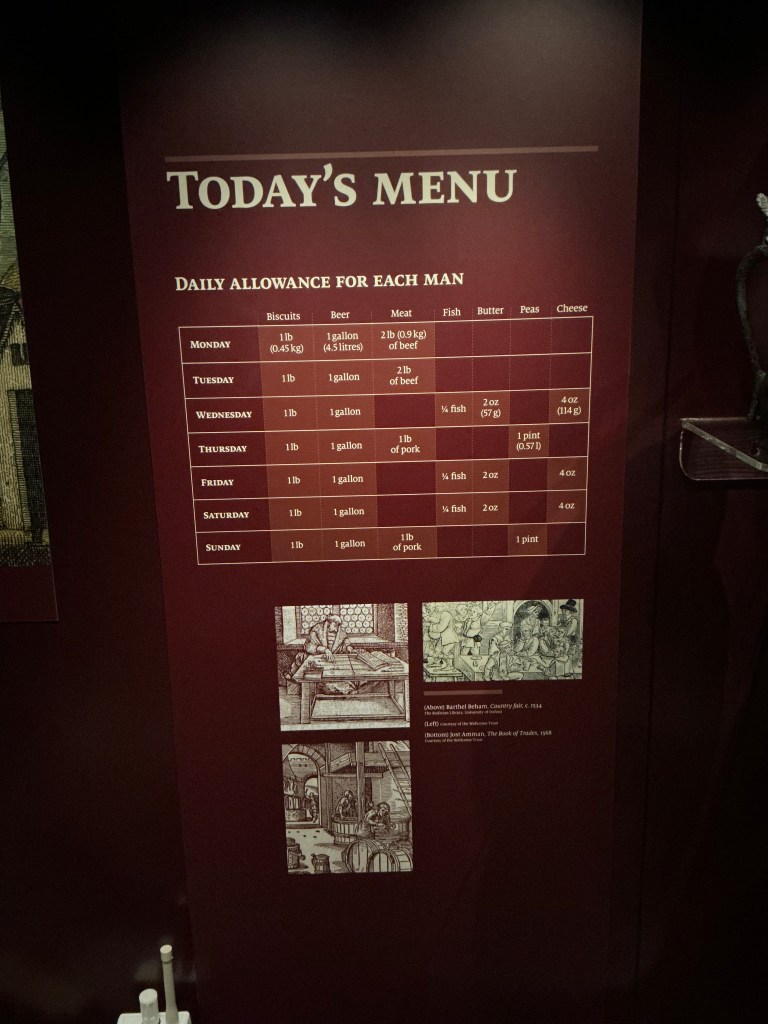
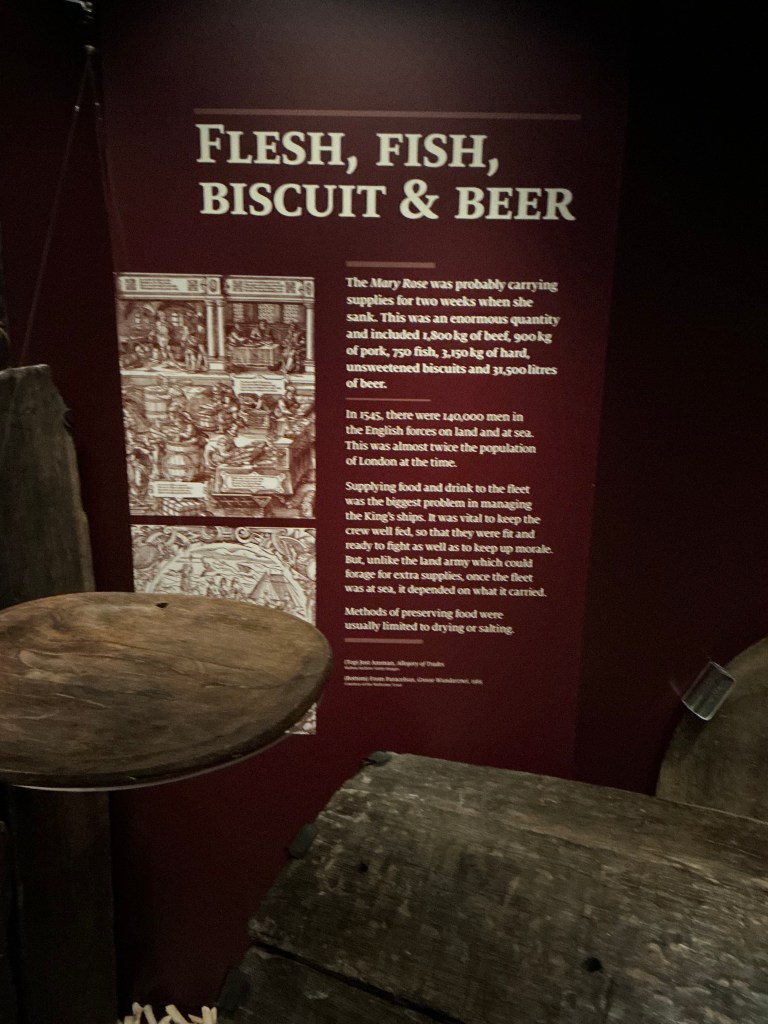
Menu, daily allowance for each man is in the Today’s Menu image, above.
The sailors always ate 0.45kg of biscuits, they had a gallon of beer and 0.9kg of beef most days of the week. They drank eight pints of beer, eight biscuits and a loaf of bread.
The ship’s galley was in the very bottom of the ship, in the hold. It was made of brick with a huge stew pot above the fire in the brick kiln. Only one of these pots survived due to the way the Mary Rose sat underwater.
The pot that did survive, as well as the oven, is too fragile to ever be used again. It was a very deep dish with a lead rim so the food would possibly have been poisonous.
The Mary Rose was possibly carrying supplies for two weeks when she sank.
1,800kg of beef was onboard when she sank and there was 900kg of pork, 750kg of fish and hard unsweetened biscuits that weighed 3,150kg and 31,500 litres of beer. This was an enormous amount for the time.
THE RECOVERY
There were three attempts to recover the Mary Rose but only one succeeded. I will tell you about the divers who were the first to see the ship under the Solent.
In 1545 an Italian salvage company Petre de Andreas and Symone de Maryne was asked to salvage the ship. They didn’t succeed, but did get the sails, spars, masts and some guns.
The name of the first recorded diver was Jacques Francis. He was working for another Italian salvage company called Piero Paola Corsi.
Nearly 300 years later Henry Abbinett was hired by fisherman because their nets were snagging on an underwater hazard. Henry was the first diver to be hired to investigate in 1836. He wanted the rights to salvage the ship but John Deane, who was a colleague of his, had also applied. John Deane got the rights.
John Deane and William Edwards then salvage guns and other objects.
The final successful sighting was by Percy Ackland on May 1st 1971. He saw three timbers sticking through the mud and silt.
He was a member of Project Solent Ships which was a group of expert divers that were trying to find Henry VIII’s warship. The founder of Project Solent Ships was Alexander McKee. He was a diver and a marine historian. He set the project up in 1965.
When Percy Ackland saw the three posts the team checked the sonar scans of the seabed.
They had rediscovered the Mary Rose.
My photos show the sketch book from Alexander McKee at the time. And the picture shows the plan being carried out by Percy Ackland at the site of the Mary Rose.
The excavation under the ship was carried out by a Royal Navy recovery diver. After this was done the Mary Rose was ready for raising on a specially constructed cradle to gently lift her out of the water after 400 years.
It was so important it was on TV and the whole world was watching.
Lots of experts contributed to raising the Mary Rose, including historians and archeaologists. This was the first underwater project to use archeological techniques to record the ship and artefacts.
Once the hull was in a dry dock in Portsmouth a temporary museum was built over her.
In 2016 the Mary Rose was moved into an upright position still on the cradle and the museum was opened to the public.
THE MARY ROSE TODAY
The New Mary Rose Museum is a specially designed building with air locks and special lighting systems to prevent the Mary Rose from decaying.
It was designed by architects WilkinsonEyre, Perkins+Will. The museum started with a temporary cover in the dry dock then construction started in 2009. The new museum opened may 2013.
When the museum was being built it was still being looked after in a sealed box. Up until 2013, the ship was sprayed with Polyethylene glycol and the ship was air dried.
In 2016 the hot box walls were removed which meant it could be viewed behind glass.
After a refit in 2016 the glass was removed and airlocks now keep the Mary Rose stable.
The Mary Rose Museum
It is a museum designed to bring the ship to life. The museum does this with projections onto the timbers of the ship that show people doing their jobs.
The floor is made so that it feels like you are walking on the decks as it has curve and you are walking beside the items that were found on the ship on the opposite side to where you are standing.
The Mary Rose still sits on the original metal barge that it was raised on. Here is a photo I took of the cradle.
The museum has three accessible floors.
I have been four times. The best bit is the big cooking pots and also the backgammon set because it’s amazing how small the pieces are and they were actually found.
The museum has a whopping 19,000 artefacts in the collection, which is amazing because they were found underwater. The rescue teams made special boxes to recover the small objects from the seabed and keep them in the silt.
More than 360,000 people visit every year.
the staff are very helpful and really know lots and lots about the Mary Rose.
My Creative Response to this project about The Mary Rose
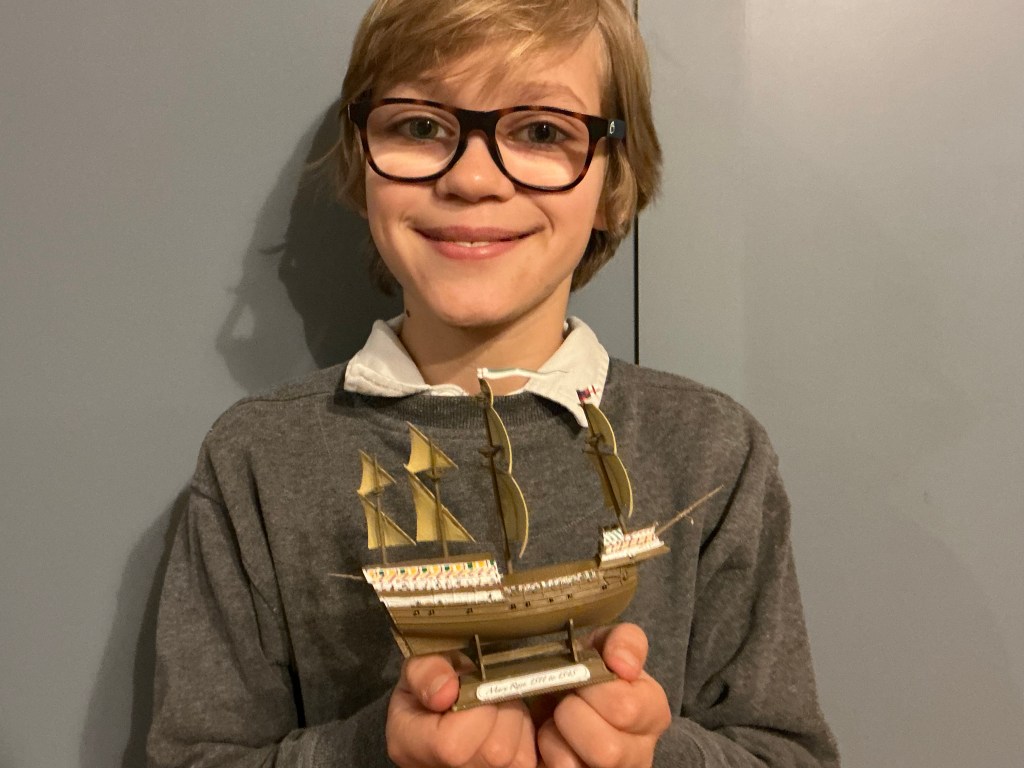
I decided to make a model of The Mary Rose because I like building and making things.
It is 1:400 scale and it took me around five hours to build with my dad’s help.
It is of the Mary Rose after the refit when the castles were added.
How and where I found out about The Mary Rose
MaryRose.org
The National Archives
Encyclopaedia Britannica
Portsmouth Historic Dockyard
Wikipedia
The British Museum
Museum staff at The Mary Rose Museum
HistoryHit.com
tudortimes.co.uk
Rowan, age 9, for my Year 8 History Project
Note from mum: Rowan chose all the information, researched it, visited the Mary Rose Museum, worked to his teacher’s brief and dictated his knowledge about each subject to fill out his chapters. I’m very proud of him because of how hard he worked on this, made all the more special because he is 9.
 AdventureswithRowan
Leave a comment